Back

2020 was an exceptional year in terms of volatility in Europe, reaching the levels of 2008 (measured by the CAC 40® Volatility Index or VCAC). Over the course of 2020 and 2021, volatility has remained higher than the average of the last five years.

As volatility increases, market quality deteriorates across all venues. However, analysis of this phenomenon is scarce, despite the fact that it is during highly volatile periods that market quality matters most for investors.

In this document, Euronext provides a short market quality analysis in order to tackle this lack of information, while opening the door for further research.

Euronext Equity Market Quality Analysis report

A short analysis, demonstrating that in times of heightened volatility, Euronext's equity market remains resilient and provides the best market quality for its listed stocks, and proving the benefits of Euronext’s liquidity schemes for investors. 

Executive Summary

  • Setting aside ‘black swan’ events such as March 2020, Euronext’s market quality remains resilient in periods of high levels of volatility compared to its main competitors.
  • The deterioration in some metrics is far less on Euronext than on other venues.
  • The impact of volatility on EBBO Presence and Setting is less noticeable on Euronext.
  • The analysis demonstrates the benefits of Euronext’s liquidity programmes and the importance of the requirements in place for clients.

Methodology

  • In this analysis, we select a basket of liquid securities that are listed on the Euronext Markets. The basket is made up of the component securities of the CAC40®, AEX® and BEL20®, the national blue-chip indices for France, the Netherlands and Belgium. By selecting these securities, we exclude the potential impact of illiquid securities. The data covers the period from 1 January 2020 to 9 September 2021.
  • The market quality metrics used in the study are provided by BMLL Technologies. Three main metrics are examined: Spread, Liquidity at Touch and Time Presence at the European Best Bid & Offer (EBBO).
  • The BMLL market quality metrics are then compared with the average annualised intraday volatility per security using the Garman-Klass volatility formula. Three buckets of volatility are identified, to take into account different market conditions.
Download Euronext market quality in times of volatility

Back

The geopolitical tensions of 2022 are bringing back volatility to the markets.

Covid outbreak

The Covid outbreak in 2020 had already marked a turning point, with volatility at consistently higher levels than historically, translating into uncertainty over future expectations. From a microstructure standpoint, market quality is considered to be very sensitive to volatility: it is generally observed to deteriorate as volatility increases.

Ukraine and Russia

Nonetheless, based on empirical observations during the ongoing crisis between Ukraine and Russia, the overall equity market in Europe now seems to be more resilient to distortions driven by global events.

Market quality metrics

In this study, Euronext provides a short analysis comparing the market quality metrics in 2020 during the first wave of the Covid-19 outbreak and the recent market turmoil in 2022 caused by the Ukraine-Russia crisis.

Euronext Equity Market Quality Analysis report 

In this report, we observe that since early 2020, volatility and equity trading volumes have skyrocketed due to global markets turmoil, but European market quality appears to be more resilient to distortions during the Ukraine-Russia crisis in early 2022 than during the first Covid-19 wave in 2020.

During these recent geopolitical tensions, Euronext has maintained stronger metrics than MTFs in terms of average spreads and EBBO Presence/Setting. 

This testifies to Euronext’s resilient market quality, proving again its reliability even in times of unprecedented levels of volatility.

Executive summary

  • Since early 2020, volatility and equity trading volumes have skyrocketed due to global market turmoil, driven by the Covid-19 pandemic waves and the ongoing Ukraine-Russia crisis.

  • European market quality has been more resilient to distortions during the Ukraine-Russia crisis in early 2022 than during the first Covid-19 wave in 2020.

  • Even during the recent geopolitical tensions, Euronext has maintained stronger metrics than MTFs in terms of average spreads and EBBO Presence/Setting

Methodology

  • Market quality metrics are analysed for CAC 40® constituents, which are among the most liquid and highly traded securities on Euronext and at pan-European level. By selecting this subset, we exclude the potential impact of illiquid securities.
  • The data range covers two volatile periods: “First Covid wave” from 3 February 2020 to 30 April 2020, and “Ukraine-Russia crisis” from 3 January 2022 to 31 March 2022.
  • The red dotted lines in the charts highlight the relevant dates during the two periods: 16 March 2020, the day the first lockdown was announced in France, and 24 February 2022, the beginning of the Ukraine-Russia crisis.
  • Volatility is evaluated using the VSTOXX® Index (V2TX), which measures the volatility of the EURO STOXX 50 Index.
  • The market quality data in this study is sourced by the independent provider BMLL Technologies, and three metrics are analysed: Spread, European Best Bid & Offer (EBBO) Setting and EBBO Presence

Download Is the Equity Market becoming more resilient to global turmoil?

Back

By Trend and Hedgeclub, Kyiv

trendhedgeclub.com

Falling agricultural commodities prices affecting the Black Sea region

Poland is one of the largest agricultural producers in Europe, with agriculture accounting for 3.8% of its GDP. However, local Polish farmers have been facing some difficulties due to falling prices of agricultural commodities undermining the profitability. This is affecting not only Poland, but the entire Black Sea region. Some claim that the price fall was due to flows of grains from Ukraine.

Poland and Hungary ban grain and food imports from Ukraine

In response, Polish farmers, along with their fellows from Slovakia, Bulgaria, Hungary and Romania, have been organising protests and strikes, demanding government support and higher prices for their crops, pushing the Polish Minister of Agriculture to resign on 5 April.  Some farmers have taken their protests a step further by blocking the import of Ukrainian grain. Several politicians asked Brussels to apply duties and quotas on Ukrainian grain, but not oilseeds and their by-products. Such moves pushed Poland and Hungary to ban grain and food imports from Ukraine on 15 April, followed by Slovakia introducing similar measures on 17 April. Meanwhile, Poland and Slovakia will continue to allow the transit of grains from Ukraine through their territories. 

Concerning reactions from the market

However, the reaction in the market has been controversial. There were concerns and accusations that some politicians in Poland try to manipulate public opinion, taking advantage of the current situation in the market, ahead of the parliamentary elections to be held later in the year. This has also raised concerns about protectionism and trade barriers.

The EU authorities have also criticised such unilateral actions by individual member states rather than having an EU-wide solution.

What is the actual impact of grain imports from Ukraine on prices?

"The amount of grain from Ukraine [via Polish borders] was not significant compared to the local crop. About 800,000 tons of wheat and 1,300,000 tons of corn have been imported to Poland since March 2022. This is not such a large amount," said Andriy Abdulov, a grain trader with the Polish company Agrolok. 

Volatile grain markets in 2022

“At the beginning of 2022, grain prices skyrocketed in the global market following the Russia’s aggression of Ukraine. Then, the prices started decreasing in March 2022 when Poland, Romania, Bulgaria, Hungary and the Baltic States decided to help Ukraine to facilitate transit of grains from Ukraine by land to final destinations as the major Ukrainian ports were blocked by the Russian navy. The grain prices kept falling on the international grains market following the creation of the "grain corridor" in July 2022 that partly restored grain shipments from Ukrainian ports,” Andriy Abdulov said.

The prices in the Polish grains market have followed the trend in the global grains market. At the same time, Poland had one of the best crops in recent years, adding pressure on prices in the local market. Exports of wheat and corn from Poland significantly exceeded the volumes of the previous years.

Petr Ciecwierz, advisor to trading company MK Merchants, also emphasises that grain prices have decreased throughout Europe, though they remain at pre-war levels.

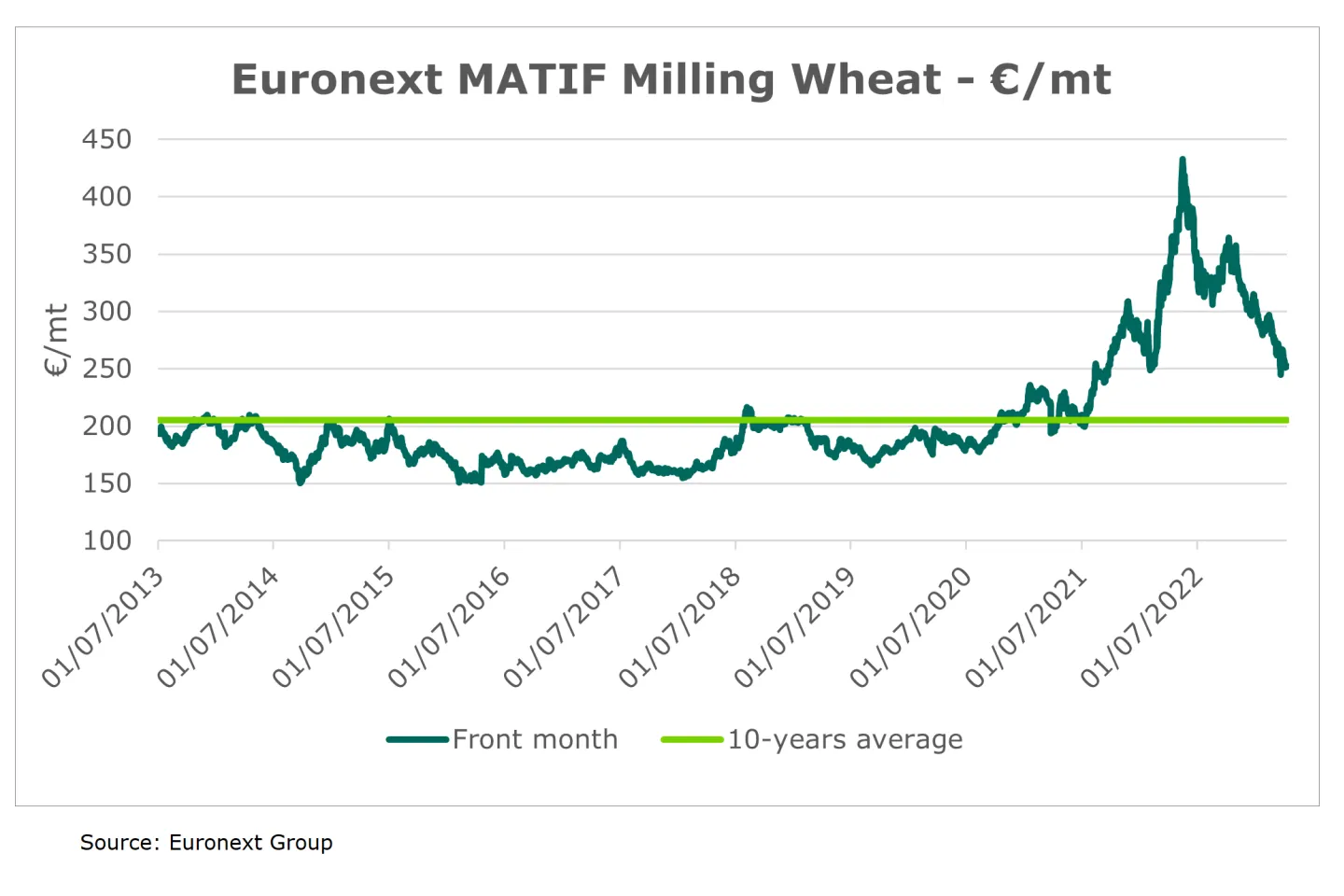
Euronext MATIF Milling Wheat Futures trade levels

Thus, Euronext Milling Wheat Futures trade around the same levels as at the beginning of February 2022, and well above the 10-year average:

Euronext Matif - Euronext Milling Wheat Futures 10-year average

The narrative behind falling grain prices

However, politicians began to use the narrative about falling prices. "We will have elections this year. The situation in agricultural markets is used by certain political parties and agricultural unions to pressure the government and get more subsidies. Not only the government, but also the political forces that are currently in the opposition, repeat the same narrative," says Petr Ciecwierz.

Are Ukrainian exports impacting Polish grain prices?

"Actually, different media sources provide different information, different data. Some politicians say that we [Poland] need to export 9 million tons of grains [to bring the stocks to usual levels], others estimate this number at 4 million tons. No one even knows how many those reserves are. Therefore, it is not true that exports from Ukraine became the main factor affecting the drop in prices and the situation in Europe," says the market participant.

Influencing market sentiment about Ukrainian grain

The second false thesis of Polish farmers is about the poor quality of Ukrainian grain and the lack of checks at the border. Petr Ciecwierz notes that there is standard quality control at the border when it comes to the EU. All agricultural products are controlled according to European standards.

"The problem is Moscow propaganda. Because agricultural media and social networks, where farmers participate, spread false information. The thesis that the grain that comes from Ukraine passes without control for pesticides, mycotoxins, and the content of insects is not true. The government tried to explain the situation, but it was very limited. They tried to refute such information, but no one listened to them," says Petr Ciecwierz.

Polish farmers putting pressure on the government on grain prices

He also notes that Polish farmers are pressing the government to solve their problems, buy grains from them at prices above the current prices or influence the trading companies buying from farmers to increase the prices. This would be completely against a free market principle. 

Another problem: Poland cannot export its grains to a number of North African countries, for instance to Egypt, as Poland cannot provide appropriate certificates for export.

Managing price risk effectively with the Euronext MATIF grain contracts

One of the solutions for farmers would be to manage the price risk in a more effective way to protect themselves from unfavourable price movements. Using diverse hedging strategies, farmers can lock in their selling price to the levels that ensure profitability. For instance, Euronext MATIF Milling Wheat Futures dropped by about €20 between 1 March and 11 April while the drop was more than €70 since August when most wheat was harvested. If farmers fixed the price of their crop between August and March by selling futures, for instance, they would achieve significantly better performances.

By Trend and Hedgeclub, Kyiv

trendhedgeclub.com


This publication is for information purposes only and is not a recommendation to engage in investment activities. This publication is provided “as is” without representation or warranty of any kind. Whilst all reasonable care has been taken to ensure the accuracy of the content, Euronext does not guarantee its accuracy or completeness. Euronext will not be held liable for any loss or damages of any nature ensuing from using, trusting or acting on information provided. No information set out or referred to in this publication shall form the basis of any contract. The creation of rights and obligations in respect of financial products that are traded on the exchanges operated by Euronext’s subsidiaries shall depend solely on the applicable rules of the market operator. All proprietary rights and interest in or connected with this publication shall vest in Euronext. No part of it may be redistributed or reproduced in any form without the prior written permission of Euronext. Euronext refers to Euronext N.V. and its affiliates. Information regarding trademarks and intellectual property rights of Euronext is located at https://www.euronext.com/terms-use.

© 2023, Euronext N.V. - All rights reserved.

Back

Why invest in thematic indices?

Thematic investing is an alternative to traditional investment, offering diversification and aiming to create long-term value on future trends.

New technologies are at the root of many thematic investments, providing early access to growth opportunities around the world before they become mainstream.

An investment strategy based on thematic indices offers investors a data-driven way to gain exposure to companies that match their interests.

As a leading index provider, Euronext aims to provide its clients with tools that expose them to this growing asset class while benefiting from high level operational and regulatory security.

Euronext Thematic Indices are to help investors identify companies that are actively implicated in a specific activity.

A sample of Euronext’s thematic indices


We are proud to present our new range of thematic indices that follow disruptive and secular growth themes including AI and Robotics, Technology, Wind and Solar, etc.

These indices target markets likely to grow faster than the global economy.

Euronext works closely with partners that prioritise high-quality data and granularity. Thematic indices go beyond traditional sector-based indices.

Euronext range of thematic indices includes:

Euronext indices are used by financial institutions all around the world with more than 15,000 ETFs, funds and derivatives associated to our indices with billions of AUM.

Learn more about Euronext thematic Indices

As a leading index provider in Europe for 40 years, Euronext has extensive expertise across a wide range of ESG and thematic indices, and is strongly engaged in supporting the financial sector’s sustainable transition. 


Contact us at index-team@euronext.com for any queries.


Back to previous page  I  Euronext Index Data Page  I  Euronext Index Team Services


Back

A wide range of biodiversity index solutions

We offer a high-level range of indices focusing on biodiversity. Euronext suite of Biodiversity Indices aims to identify companies that are managing well their material biodiversity impacts from different perspectives, either by excluding the worst performers or by selecting the best performers.

Why invest in biodiversity?

Biodiversity is essential to sustaining humanity and all life on earth. Nature plays a critical role in sustaining life, it covers the processes that make up our ecosystems and gives us clear water, air, food and medicines. The current acceleration of global biodiversity loss is one of the most significant threats to society (OECD, 2019). 

Human-driven biodiversity loss is one of today’s main challenges: financial institutions and companies are encouraged to monitor and disclose their risks and negative impacts on biodiversity and the demand for index solutions that consider the biodiversity impact of companies is still growing. Financial institutions have an important role to play in tackling the preservation of biodiversity. 

Euronext, as a leading pan-European index provider, is strongly committed to early action. 

Euronext biodiversity indices key principles

On top of excluding companies with a high negative impact on biodiversity, the index methodology also includes broad ESG consideration with exclusions based on controversial products involvement exclusions and UN Global Compact principles controversy.

Our suite of Biodiversity indices:

Euronext awarded for Biodiversity Indices


Image removed.


The Euronext® Euro Large Cap Biodiversity Leaders 30 Index has been awarded “Index of the Year 2023” by structured products data and market intelligence provider at SRP Europe 2023.

Image removed.


Euronext has also won “Excellence Award for Robust Biodiversity Solutions 2023” by neutral and independent finance experts at the Wealth&Finance Awards 2023.


Euronext indices are used by financial institutions all around the world with more than 15,000 ETFs, funds and derivatives associated to our indices with billions of AUM.


As a leading index provider in Europe for 40 years, Euronext has extensive expertise across a wide range of ESG and thematic indices, and is strongly engaged in supporting the financial sector’s sustainable transition. Our ability to adapt and offer suitable and innovative solutions to our clients makes Euronext one of the main ESG index providers.


Contact us at index-team@euronext.com for any queries.


Back to previous page  |  Euronext Index Data Page  |  Euronext Index Team Services


Back

The new Data Services and Analytics team will help Euronext Securities realise its ambitions to become more data-driven and capitalise on data to offer customers more value-added data services.

Over the past few years, datamining and analytics have become one of the most prominent trends in the financial services arena. Data-driven insights play a key role in making decisions and understanding market and investor behaviour, and more CSDs are realising their untapped data potential.

Christian Viken, Executive Vice President and Head of Customer Experience and Analytics at Euronext Securities Oslo, explains:

Euronext’s network of CSDs holds a unique data set with millions of private and institutional investors, divided over 4.5 million securities accounts with aggregated assets under custody of EUR 6 bilion

“With our new Data Services Team, we will be able to prioritise developing ancillary services based on our data, so we can deliver new value-adding products to existing and new customers alike.”

Moving from data governance to advanced analytics

In addition to developing value-added services, Euronext Securities will focus on scaling these services – expanding them from a local product offering through one CSD to a cross-border offering across all Euronext CSDs and opening the services to more customers and markets than is the case today. “Traditionally, our CSDs have been part of their local market infrastructure and have typically worked with a limited customer base,” Christian Viken says. “Now, we’re broadening our approach and partnering with data providers, fintech and other companies who wouldn’t traditionally be customers of a CSD.”

The new team is a part of a larger, five-year data services strategy, which Euronext Securities initiated in 2018. The strategy’s initial phases covered data governance, structure and visualisation, and the company has now entered the product development and data distribution phases, where Euronext Securities is actively bringing new products to market and creating new channels for distributing data to new and existing customers. The final phase is to develop a Euronext Securities data hub, which will leverage advanced analytics to help customers use available data more effectively.

The first data products will focus on settlement data and reports, covering areas like settlement fail trades and predictions, penalty data, efficiency and liquidity. “With all the recent regulations targeting settlement efficiency, we can see that this area is top-of-mind for our customers,” states Christian Viken. “They’re asking us if we can develop solutions that can strengthen the monitoring of settlement processes and take the most time-consuming pain points within the process and make them more efficient.”

Leveraging the power of a diverse CSD network

Creating a cross-CSD data services team and a harmonised product portfolio enables Euronext Securities to capitalise on the strengths and competencies each Euronext CSD has to offer. For example, Euronext Securities Oslo has considerable experience in commercialising data products, such as TradeLog, which streamlines the monitoring of employees’ personal trading activity through electronic pre-clearance, screening list capabilities and automated rule checking. TradeLog has been a tremendous success in Norway and is now one of the first products to be expanded across all Euronext CSDs, starting in Denmark. Transaction Monitoring – a digital web solution that enables customers to monitor transactions across their entire investor base – is another example of a data service product initially offered in Euronext Securities Oslo and now in the process of being rolled out in Denmark.

And central to harmonising the entire data services product portfolio is the technical expertise that Euronext Securities Milan brings to the table, as Christian Viken points out. “All of the settlement products that we are now bringing to market were created in Euronext Securities Milan,” he says. “They have a mature infrastructure and understanding of the applications we need to develop our data services products, including AI, machine learning and advanced data technology, not to mention their partnership with universities offering  Data Science master’s programmes.”

This combination of commercial experience, infrastructure and IT prowess provides an excellent foundation for creating innovative data services. And this innovation, as Christian Viken sees it, is an essential ingredient for growth.

Data is one of the most valuable assets that any company holds, and we have made significant strides in turning our data into added-value services that will help our customers work more efficiently and make better decisions. We look forward to bringing our data services portfolio to new and existing customers in all Euronext Securities’ markets.

The Euronext Securities data strategy is aligned with the overall Euronext strategy for data services.

Contact

Christian Alexander Viken

Head of Data & Analytics

Euronext Securities

CAViken@euronext.com