-
Listing
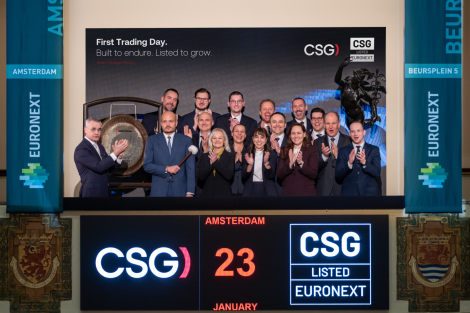
Strengthening Europe’s strategic autonomy through capital marketsCzechoslovak Group lists on EuronextRead moreWorld’s largest defence IPO ever recorded.
Learn more about Euronext’s initiatives to enhance financing and visibility for European aerospace and defence companies -
Trading
Where European Government Bonds meet the futureFixed Income derivativesRead moreTrade Mini Bond Futures on main European Government Bonds
-
Clearing
Step into Europe’s next phase of Repo ClearingRepo ClearingRead moreEuronext is expanding its repo clearing services to boost market access, liquidity provision and collateral optimisation across Europe.
-
CSD
European CSD modelBuilding the CSD of Choice in EuropeRead moreEuronext Securities is shaping the future of European capital markets by enhancing integration, connectivity, and innovation.
-
Technology
Euronext Technology SolutionsHigh-Frequency Trading Solution (HFTS)Read moreThe new generation of high-frequency risk trading platforms, offering the highest performance with ultra-low latency and minimal jitter, all at a low total cost of ownership.
-
Data
-
Indices
Access the white paperInvesting in the future of Europe with innovative indicesRead moreThe first edition of the Euronext Index Outlook series with a particular focus on the European Strategic Autonomy Index.
- Regulation
-
About Euronext
Euronext strategic planInnovate for Growth 2027Read moreShaping capital markets for future generations
Euronext launches new AEX® ESG Index
Investor Relations seminar on 8 June
08/06/2022
NIRF and Oslo Børs invites to Investor Relations seminar on 8 June.
- Seminar
- Norway
ESG Reporting: the new Guide for issuers
On 12 May 2022 Euronext announced the new edition of its ESG Reporting Guide. The guide is designed to help companies engage in climate change mitigation policies with the support of their investors, and more broadly lists the key aspects to consider when reporting on ESG to make the most of the associated opportunities. This new edition has been revised with a focus on the 1.5°C global temperature increase trajectory, in line with Euronext's “Fit for 1.5°” commitment, one of the key pillars of its “Growth for Impact 2024” strategic plan.
DOWNLOAD THE EURONEXT ESG REPORTING GUIDE
In particular, the guide aims to help companies to:
- identify and prioritise ESG opportunities and risks;
- report efficiently on the management of – and performance in – key areas of ESG transformation;
- navigate, comply with and stay ahead of regulations that require disclosure of financially material ESG information;
- differentiate themselves, ensuring the relevance of their ESG strategy in light of rapidly evolving market standards.
It also aims to support SMEs as they navigate this rapidly-evolving environment by taking into account the challenges of companies preparing disclosure for the first time, in particular small and mid-cap companies.
Since its first publication in 2020, the Euronext ESG Reporting Guide has become a reference document for listed companies and their advisers. Drawing on the model issued by the UN Sustainable Stock Exchanges Initiative, this new version is enriched with contributions from Euronext issuers on best practices in ESG reporting, in the form of case studies. It takes into account the latest developments in climate-related standards and initiatives, including those applied by investors.
Euronext is the leading European listing venue operating regulated exchanges in Belgium, France, Ireland, Italy, the Netherlands, Norway and Portugal, with close to 2,000 equity issuers. We aim to equip listed companies with the tools they need to meet the increasingly sophisticated expectations of their stakeholders around transparency on sustainability.
This initiative forms part of our sustainability strategy, “Fit For 1.5°”, a commitment to developing services and products that help Euronext’s clients, partners, and the European economy as a whole to curb the increase in global temperatures and transition to more sustainable business practices.
This commitment is key to Euronext’s purpose to shape financial markets for future generations.
Learn more about the ESG strategies of Enel, Gjensidige, Kering, Signify, and Snam
Information about Euronext’s ESG Advisory services
CAC 40 ESG Index Future
Combining CAC 40 economic performance with Environmental, Social and Governance (ESG) objectives.
- Trade a future contract based on Euronext’s first national ESG benchmark (derived from the CAC 40® index family)
- Manage and hedge ESG portfolios efficiently and in compliance with ESG principles
- Benefit from an on-screen liquidity provided by market makers committed towards sustainable finance
- Invest in the CAC 40 ESG index showing a strong methodology (powered by Moody’s ESG Solutions data) aligned with the French SRI label and the UN Global Compact principles, and excluding companies involved in coal, controversial weapons and tobacco activities
Future on the CAC 40 ESG index
Market makers
|
Image
|
Image
|
Resources
caC 40 ESG Index Future live prices
CAC 40 ESG Index Future press release CAC 40 ESG Index Future media Centre
Vendor codes
- Bloomberg: CFSA Index
- Reuters: 0#FCG:
More about the CAC 40 ESG Index
CAC 40 ESG Index Webpage CAC 40 ESG Index Brochure
CAC 40 ESG Index Live prices ESG indices
ESG 80 Derivatives
The Euronext Eurozone ESG 80 index shows the performance of 80 large cap companies in the Eurozone selected for their Environmental, Social and Governance (ESG) and energy transition performance.
Derivatives on the Euronext Eurozone ESG Large 80 index
Supporting the transition to a sustainable economy in the Eurozone.
Take exposure to the Eurozone’s sustainable economy
In line with our ESG commitment, we launched derivatives contracts on the Euronext Eurozone ESG Large 80 index (ESG 80) to allow investors to support climate action.
- Invest in the Euronext® Eurozone ESG Large 80 Index*, which shows the performance of 80 large cap companies in the Eurozone selected for their Environmental, Social and Governance (ESG) and energy transition performance.
- Trade ESG 80 Futures, Standard and Mini Options contracts offering the benefits of central clearing, including margin efficiencies with other Euronext benchmarks.
- Retail investors can trade related ETFs and Structured Products such as BNP Paribas' Certificate 100% Euronext Eurozone ESG Large 80 NR and Societe Generale's unlimited Turbos and 100% Trackers.
- Access easily the Eurozone's sustainable economy thanks to the most attractive pricing in the industry.
- Enjoy guaranteed liquidity with dedicated market makers committed to facilitating the development of sustainable finance.
* Powered by Moody's ESG Solutions
Trade Futures, Standard and Mini Options contracts on the Euronext Eurozone ESG Large 80 index
Euronext ESG Large 80 Index Future Euronext Eurozone ESG Large 80 Option
Euronext Eurozone ESG Large 80 Mini Option
Market Makers*
Trading in Euronext® Eurozone ESG Large 80 index derivatives benefits from on-screen liquidity provided by market makers committed towards sustainable finance.
*Market makers (Futures) will be associated as partners in this initiative and will benefit from a revenue-sharing scheme (15% of net trading revenue calculated on a yearly basis).
Futures
|
Image
|
Image
|
Image
|
Image
|
Options
|
|
Resources
Euronext® Eurozone ESG Large 80 index live prices
Euronext® Eurozone ESG Large 80 index media centre
Euronext announces volumes for April 2022
EUROAPI lists on Euronext Paris
Euronext launches the OBX® ESG index
The move towards a border-free European bond issuance market
The Eurobond market has often been described as conservative. Participants rely on
established, proven ways of doing business, and change often comes slowly and out of
necessity rather than the desire for innovation or reinvention. Thus, when Autostrade made
history by issuing the very first euro bond on 17 July 1963, it wasn’t about challenging the
status quo. Autostrade needed to procure financing outside of its local market, and so the
company worked with a UK-based law firm and issued its bond on the Luxembourg stock
exchange. The move was without precedent, so it needed to create a new market practice. In
time, that new practice became the industry standard.
In the decades that followed, issuance basically followed one of two approaches: local or
global. If an issuer wanted to address the local market and investors, they issued in the
local currency, under local law and through the local CSD. On the other hand, if that issuer
wanted to address an international market, they used the global note scheme. They issued
under UK law, listed the bond on the Luxembourg or Dublin stock exchange, and went
through the ICSDs with cash settlement in commercial bank money. Almost 60 years later,
the process is well established and, on the surface, there is no strong impetus for change.
However, developments over the past 20 years indicate that a shift in market practice could
be imminent.
The desire to create a capital markets union in Europe is not new. The Treaty of Rome, signed in
1957, included as one of its objectives the desire for free capital movement. When the euro was
introduced in 1999, focus on EU-wide financial activity increased. Then in 2001, the Giovannini
Group published a report identifying 15 barriers to the efficient functioning and development of
cross-border clearing and settlement. The conclusion was that there were significant technical,
tax and legal barriers to creating a capital markets union. The desire, however, remains, and many
European financial policy makers believe the formation of this union is a necessity to compete
in the global marketplace. And thus, over the past 20 years, authorities have passed several
regulations in the effort to create a level playing field, and ensure cross-border competition and
harmonisation.
Download white paper - European Bond Issuance Market Benefits