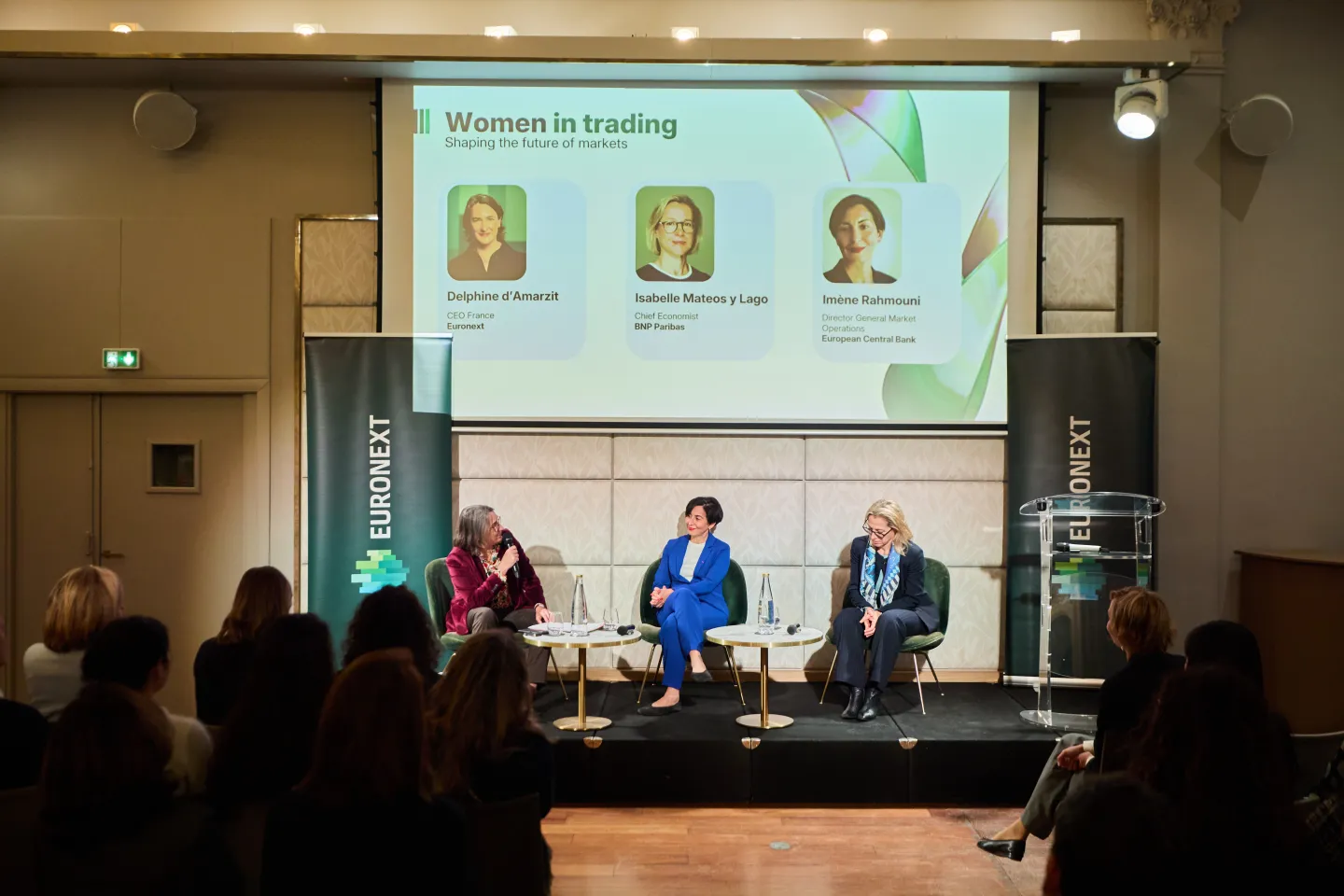



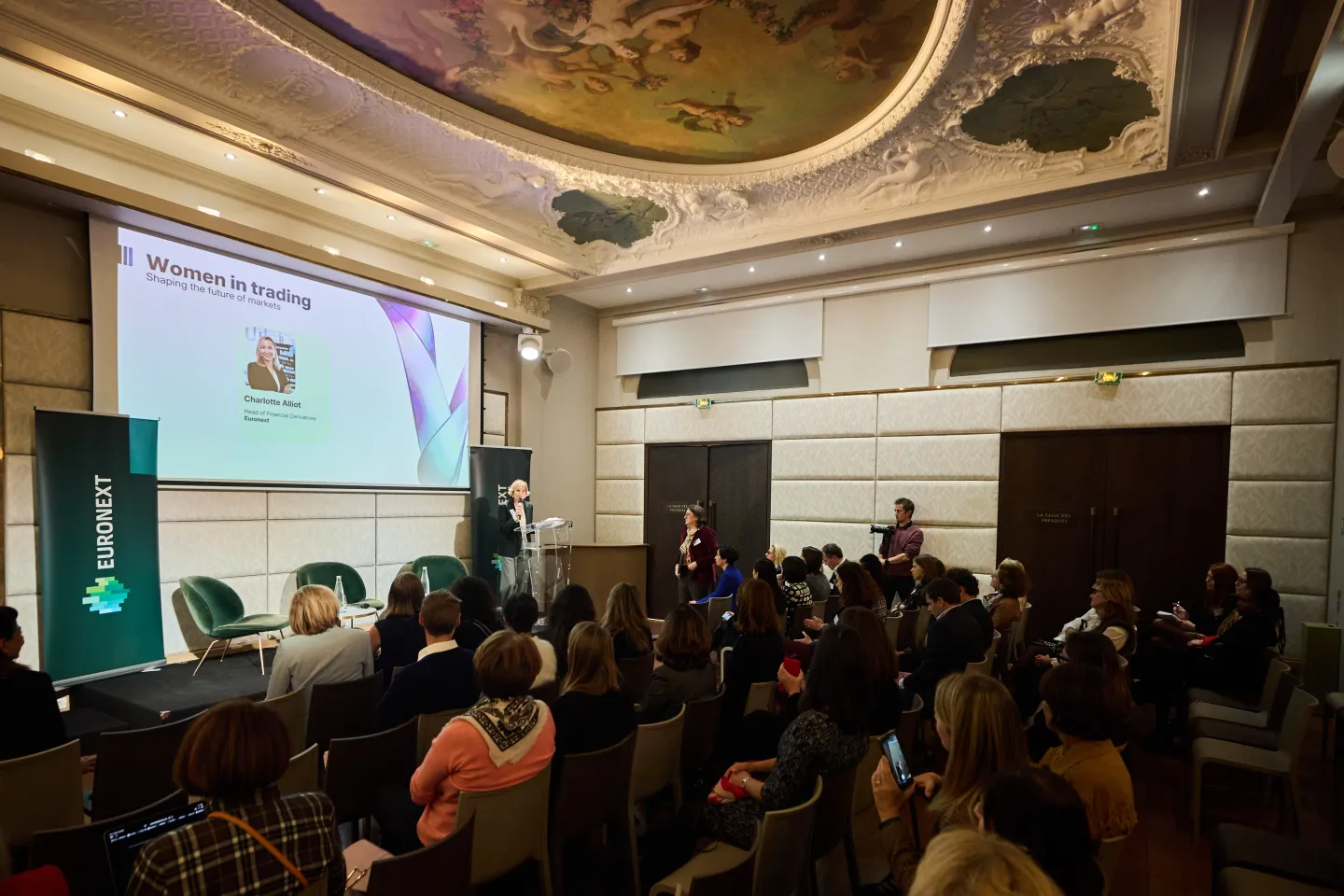
On 3 November 2026, Euronext hosted the fourth edition of its annual Women in Trading event in Paris, bringing together professionals from across the financial industry to exchange perspectives, share expertise and explore the forces shaping the future of financial markets.
Organised in partnership with Women in Finance France, this year's edition was the largest to date and provided a platform to discuss some of the most pertinent questions facing the financial industry today, from the rise of interest rates and the resilience of European capital markets to the financing of the real economy and the transformation of market infrastructure.
Following a welcome address by Charlotte Alliot, Head of Financial Derivatives – EQD & FID at Euronext, the event featured a panel discussion moderated by Delphine d'Amarzit, CEO of Euronext Paris and member of the Managing Board, with Isabelle Mateos y Lago, Chief Economist at BNP Paribas, and Imène Rahmouni, Director General Market Operations at the European Central Bank.
The market implications of a changing interest rate environment
A central focus of this year's edition of Women in Trading was the rise in long-term interest rates and what it means for financial markets, investors and the economy as a whole.
The panel discussion explored the multiple factors influencing long-term interest rates, including inflation expectations, real interest rates, government bond supply and demand, and changing investor risk appetite.
With significant financing requirements across governments and businesses, bond markets are facing substantial issuance needs at a time when competition for capital is intensifying. Investment in areas such as artificial intelligence, geopolitical developments and energy-related priorities are all contributing to growing demand for financing.
These developments have important implications for the broader economy. Higher financing costs can weigh on interest-rate-sensitive sectors, while changing expectations around growth, inflation and monetary policy continue to influence investor behaviour and asset valuations.
The discussion highlighted the importance of understanding these interconnected market dynamics and their implications across the financial value chain.
Liquidity, resilience and financial sovereignty in European capital markets
Beyond interest rates, the structure and resilience of European financial markets emerged as another important theme. Bond markets are evolving, with non-bank financial institutions playing an increasingly significant role in market liquidity. At the same time, substantial issuance volumes and changing financing conditions raise important questions around the availability of liquidity, credit risk and the stability of financial markets.
The discussion also considered how today's financial environment compares with previous periods of market stress, including the European sovereign debt crisis. While Europe’s financial architecture has strengthened, questions around sovereign risk, differences in borrowing costs and the transmission of financial stress remain relevant. These questions are closely linked to Europe's broader ambition to strengthen its financial sovereignty and resilience.
Mobilising European savings to finance the real economy
One of the most important challenges facing European capital markets is how to better connect Europe's substantial savings with investment opportunities within the region. Although European households and institutions hold significant financial resources, a considerable challenge remains in channelling this capital towards European businesses and productive investment.
Strengthening Europe's investor base is therefore essential. This means creating the right conditions for households and institutional investors to participate more actively in capital markets, while ensuring that European companies have access to the financing they need to grow and innovate.
The discussion highlighted the importance of building an attractive investment environment, supported by competitive returns and appropriate long-term investment structures.
Tokenisation and the future of market infrastructure
Technology is also reshaping the way financial markets operate, with tokenisation emerging as a significant development for the next generation of market infrastructure. By enabling financial assets to be represented and transferred digitally, tokenisation has the potential to improve efficiency, speed and connectivity across financial markets.
The role of trusted settlement assets, particularly central bank money, remains an important consideration in this evolution. As financial markets explore new technologies and operating models, maintaining confidence and security will be essential.
Looking further ahead, these developments raise important questions about the future organisation of financial markets, including the potential for greater integration, continuous availability and more programmable market infrastructure. For the financial industry, the challenge will be to translate these technological possibilities into practical improvements that benefit market participants and the wider economy.
Shaping the future of European capital markets
From the evolution of interest rates and the resilience of bond markets to the mobilisation of savings, financial sovereignty and technological transformation, the themes explored at Euronext Women in Trading 2026 reflect the broader question of how Europe can strengthen its financial ecosystem and take greater control of its economic future.
As the discussion highlighted, achieving this will require collaboration, innovation and a long-term perspective. Developing deeper capital markets, supporting investment in European businesses and embracing new technologies will all be important in ensuring that financial markets continue to serve the needs of the real economy.
At the same time, bringing more diverse perspectives into these conversations is essential to building a stronger and more inclusive financial industry. Through Women in Trading, Euronext remains committed to providing a platform for women across the financial sector to share knowledge, build connections and contribute to shaping the future of capital markets.
Discover the previous editions of Euronext Women in Trading: the first edition, second edition and third edition.