

T+1 settlement in Europe is a regulatory development that is part of a broader shift towards faster settlement cycles, designed to improve market efficiency, reduce systemic risk, and align with international standards. Euronext is fully committed to a smooth transition throughout the entire value chain by October 2027. 

What is T+1?

The transition to T+1 settlement is an EU-wide initiative that represents a structural, operational and organisational transformation of European financial markets. 

The new T+1 model shortens the EU securities settlement cycle, which is currently set to T+2. Under the new model, the settlement of securities transactions (the delivery of the securities and cash, if applicable, from buyer to seller), is completed on the business day immediately following the trade date (T+1).

The go-live for the transition to T+1 is scheduled for 11 October 2027.

Why change the settlement cycle to T+1?

This regulatory development is part of a broader international movement towards accelerated settlement cycles. The move to T+1 is designed to enhance market efficiency, reduce counterparty and market risk, and ensure alignment with global standards.

T+1 timeline

The European Securities and Markets Authority (ESMA) published a final report in November 2024 confirming the transition to a T+1 settlement cycle for European markets. The transition will be effective no later than 11 October 2027.
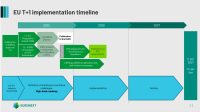
T+1 planning illustration
 

T+1 at Euronext

Euronext supports the move to T+1, which will make European markets more efficient for market participants through reduced capital and liquidity immobilisation in post-trade operations. 

Euronext implementation approach 

Euronext’s scalable and agile systems are fully capable of supporting a shorter settlement cycle. 

Euronext teams are working closely with clients and partners to ensure their operational and technical readiness for the implementation of the T+1 settlement cycle in October 2027.

Key actions at Euronext:

T+1 programme

Euronext has put in place a cross-business T+1 Settlement Programme sponsored by senior executives.

The programme aims to:

  • ensure Euronext’s full compliance with the recommendations set out by the T+1 Industry Committee, across its regulated markets, central clearing counterparty (CCP) and central securities depository (CSD) network
  • secure client readiness
  • guarantee consistent and clear engagement with all relevant stakeholders.

Active industry contribution

In addition to securing its own readiness, Euronext is working actively with regulators, authorities, clients and partners to ensure a seamless transition for all. 

Euronext is a committed stakeholder of the T+1 Industry Committee, which is responsible for driving the transition to a T+1 settlement cycle across the EU securities markets. Euronext Group representatives act as co-leads of key technical workstreams for the committee.

Alignment with Euronext strategy

Beyond being an active player in the successful transition to T+1, Euronext is committed to support a united, integrated, and strong European capital market, driving the growth of European companies and strengthening Europe’s financial future.

FAQ

T+1 refers to the length of the settlement cycle. Under T+1, settlement takes place one day (+1) after trading (T). Currently the settlement cycle for transactions made on EU trading venues is set to T+2. The initiative at EU level to shorten the settlement cycle involves moving from the current T+2 model to a cycle in which the settlement of securities transaction, that is, the delivery of the securities, and cash, if applicable, from buyer to seller is completed on the business day immediately following the trade date (T+1). 

The main drivers behind the move to T+1 are to reduce counterparty and market risk, enhance settlement efficiency, and bring European markets in line with other major global economies. The transition also supports the EU’s broader objective of making its capital markets modern, competitive and attractive to global investors.

The main drivers behind the move to T+1 are to reduce counterparty and market risk, enhance settlement efficiency, and bring European markets in line with other major global economies. The transition also supports the EU’s broader objective of making its capital markets modern, competitive and attractive to global investors.

No, the recommendations themselves are not legally enforceable. They follow an “Adhere or Explain” model, meaning that if a firm decides not to apply them, it should inform its stakeholders and outline the reasons behind that choice to help minimise negative impacts. However, the roadmap recommendations may become obligatory upon their incorporation into the Regulatory Technical Standards (RTS) developed by the European Securities and Markets Authority (ESMA). Once adopted by the European Commission, these RTS have binding legal effect across all EU member states, and firms will be legally required to comply with them. 

The implementation of T+1 settlement across the EU and EEA is set for 11th October 2027, as agreed by EU co-legislators. 

Next steps and further information

We encourage all clients to review their operational readiness, engage with our project teams and participate in upcoming testing activities. 

To find out more about T+1 impacts across the entire value chain, clients can refer to the information specific to their business area:

Trading clients

see the Euronext Connect Customer Portal  

MTS clients

See MTS website

Clearing clients

see the Euronext Connect Customer Portal  

Settlement clients

contact the Euronext Securities teams in your location