-
Listing
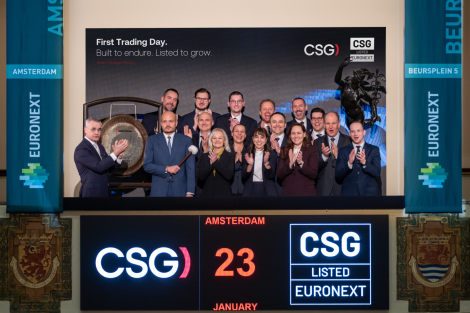 Strengthening Europe’s strategic autonomy through capital marketsCzechoslovak Group lists on EuronextRead more
World’s largest defence IPO ever recorded.
Learn more about Euronext’s initiatives to enhance financing and visibility for European aerospace and defence companies -
Trading
 Where European Government Bonds meet the futureFixed Income derivativesRead more
Trade Mini Bond Futures on main European Government Bonds
-
Clearing
 Step into Europe’s next phase of Repo ClearingRepo ClearingRead more
Euronext is expanding its repo clearing services to boost market access, liquidity provision and collateral optimisation across Europe.
-
CSD
 European CSD modelBuilding the CSD of Choice in EuropeRead more
Euronext Securities is shaping the future of European capital markets by enhancing integration, connectivity, and innovation.
-
Technology
 Euronext Technology SolutionsHigh-Frequency Trading Solution (HFTS)Read more
The new generation of high-frequency risk trading platforms, offering the highest performance with ultra-low latency and minimal jitter, all at a low total cost of ownership.
-
Data
-
Indices
 Access the white paperInvesting in the future of Europe with innovative indicesRead more
The first edition of the Euronext Index Outlook series with a particular focus on the European Strategic Autonomy Index.
-
About Euronext
 Euronext strategic planInnovate for Growth 2027Read more
Shaping capital markets for future generations

RedFish LongTerm Capital S.p.A. lists on Euronext Growth Milan
Cross-border issuance calls for partnership
Companies are becoming increasingly aware of international opportunities in terms of capital structure and investor reach. Leading legal adviser Gorrissen Federspiel regularly deals with the technical and legal complexities in the growing field of cross-border issuance.
Capital markets are increasingly international in nature. Initiatives in Europe such as the CSD (Central Security Depository) Regulation and the Shareholder Rights Directive support a common international marketplace, but company law and securities regulation are still primarily subject to national legislation. The capital markets practice at Danish law firm Gorrissen Federspiel sees increasing internationalisation of its business, and with that comes greater complexity. Customary equity issuance by a Danish company under Danish law on the Danish stock exchange is a structured process whereby the dialogue with the CSD is limited, since the technical infrastructure is already known to the participants. In contrast, cross-border issuance has a number of more complex technical and legal aspects which make closer partnership with CSDs highly relevant.
Cross-border issuance on the rise
“We now have more Danish companies considering listing abroad, and foreign companies looking at Denmark as a listing venue, than ever before. The number of cases is still limited, but there are always one or two ongoing client projects that involve cross-border issuance and international set-ups,” says Rikke Schiøtt Petersen. She is head of the capital markets practice and partner at Gorrissen Federspiel, where she primarily deals with securities law, M&A, corporate law and corporate governance.
“In terms of cross-border issuance, we have a very good working relationship with VP Securities. They are a strong and knowledgeable partner when it comes to more complicated set-ups. This involves more than getting the technical connection from CSD to CSD right. I appreciate our informal discussion of both legal and technical issues, so that we can advise our clients on the best possible solution,” she says.
VP Securities has been part of solutions for both bonds and shares in cross-border set-ups crossing the Danish border in both directions. The philosophy is that the financial infrastructure should support the capital market and help companies to attract a transparent and effective flow of capital. As all securities are dematerialised, this is primarily a technological set-up, with a set of building blocks to be assembled according to the legal differences involved in cross-border securities trading.
Communication is key
The capital market practice at Gorrissen Federspiel is a well-reputed leading player in the Danish market and holds a strong record for demonstrated excellence. For decades, Gorrissen Federspiel has been a top securities practice representing issuers, underwriters and other market participants, as well as investors and management. In assisting Danish and foreign industrial and financial clients, Rikke Schiøtt Petersen appreciates the communication aspects of international set-ups, since international advisory teams, with banks, law firms and CSDs, need an understanding of Danish law and securities infrastructure.
At Gorrissen, we frequently invite VP to take part in the early stages, to give an in-depth explanation of the specific aspects of the Danish model. In many cases, it has proved valuable for international partners and counterparties to learn about this directly from the CSD. When we have the business and the CSD proactively engaged at the table, the process will be faster and leaner
Rikke Schiøtt Petersen, Partner at Gorrissen Federspiel
Deep knowledge
Rikke Schiøtt Petersen has been a partner at Gorrissen Federspiel since 2006, and she has seen a wide variety of cross-border issuances involving both Danish and foreign companies, and including investor reach in many markets. Different national standards, different legislation and different technical capabilities can make cross-border issuance complex, and advice on the best way to achieve the client’s objectives may call for deep knowledge and a degree of creativity. VP has been a strong partner in cutting through the complexity, and for Gorrissen Federspiel this is all about helping clients to achieve their goals in the most cost-efficient way.
We’re happy to assist legal experts like Gorrissen Federspiel in the early stages of the process. Even though the technical set-up is mostly viewed as an operational implementation of the business goal in a cross-border project, infrastructure can still be the factor determining whether a project is viable or not. By bringing infrastructure to the table at an early stage, top advisers can add value and even find a way that may have been hidden by the technical and legal complexities associated with cross-border issuance.
Flemming Merring, Head of Issuer Services at VP
Gorrissen Federspiel has represented many leading underwriters and many Danish issuers and, during the past decade, the law firm has also been involved in significant equity and debt offerings and larger IPOs.
Investor relations going digital
Solar’s investor relations are becoming more and more digitised, just like the entire business. A longstanding relationship with VP is an integrated element of a cost effective and innovative approach to IR.
“More than half of our business is now related to our webshop, and it is natural for our investor relations to have the same trend. We’ve gone online with our annual reports, which is a good business case. We have also introduced partly electronic AGMs, with streaming for online participants. VP has been with us on this journey, and the team at VP INVESTOR SERVICES is a dedicated partner that challenges us, just as we challenge them,” says Charlotte Risskov Kræfting, Director, Stakeholder Relations at Solar A/S.
Solar Group is a leading European sourcing and services company, operating primarily within electrical, heating and plumbing, and ventilation technologies. The core business is product sourcing, value-adding services and optimisation of the customers’ business. Annual revenue is well beyond DKK 11 billion, and Solar employs around 3,000 employees. Solar is listed on Nasdaq Copenhagen with the short designation SOLAR B and has been listed since 1953. The stock is included in the MidCap+ index.
Longstanding partner
“I’ve been with the company for eight years and during this time our business and also investor relations have undergone some fundamental changes. VP INVESTOR SERVICES has been a partner all the way, and we benefit from a wide range of products and services, including shareholder register, insider management, IR Management - a CRM system with investors, annual general meeting, investor portal and election of employee representatives to the Board of Directors. The core is, of course, all the data related to shares and owners, and VP has skilfully built a range of good services on top of that,” says Charlotte Risskov Kræfting.
The digital element is increasingly part of many aspects of managing investor relations. With its around 3,600 shareholders, Solar is big enough to achieve tangible benefits from digitising IR. When Solar went from printed to online annual reports, and when management of access and voting rights at the AGM all went digital, using VP INVESTOR SERVICES, Solar became more efficient and saved costs related to IR.
Digital and trusted adviser
“The great benefit from partnering with VP is that they come up with digital solutions to a range of generic problems for listed companies. The insider rules in MAR are a perfect example, since we rely on VP to have all the legal and formal requirements top of mind in their design of vp.INSIDER. I expect VP to be alert and to provide solutions in response to new legislation, such as the forthcoming GDPR Regulation, and this is a huge advantage for us,” says Charlotte Risskov Kræfting, who heads a three-person team handling all of Solar’s Communication and Investor Relations.
The relationship between Solar and VP INVESTOR SERVICES goes two ways, since Solar may challenge the team at VP, or VP’s professionals may come up with new ideas as proposals to Solar. The peak season for the partnership is the AGM, where the team from VP runs a range of services and is present at the meeting to handle the identification of shareholders, admission control, voting processes and much more. The basic material is the data from the shareholder register, which is accessible via the investor portal. A relatively new feature for Solar is the partly digital AGM with streaming to shareholders.
“Not all shareholders are happy about the digitisation, but looking beyond Denmark, we can see that this is an overall trend, and for Solar this reflects how our business is becoming more digital. We want to keep following this trend, and VP INVESTOR SERVICES is a good partner to have on our side. The team at VP is also down to earth at the operational level and a knowledgeable and experienced adviser,” says Charlotte Risskov Kræfting.
Fighting for attention
Running an investor roadshow with the CFO and CEO of the company, and fighting for attention for the Solar brand, Charlotte Risskov Kræfting shares a challenge with other MidCap companies. It is increasingly harder to get analyst and media attention, since banks are devoting fewer resources to analysing the stock of medium-sized companies. Today, fewer analysts are very knowledgeable about Solar than some years ago. Solar is therefore turning to social media to boost awareness of the brand. Becoming more efficient in the “back office” of investor relations is freeing up time and attention to work more on the outside, to attract interest in the Solar stock.
Cross-border issuance at Danske Bank fuels greater operational gains and benefits for their customers
Danske Bank issues structured bonds in both EUR and DKK at VP Securities. This gives operational benefits, while also enhancing customer satisfaction.
“There’s no difference between EUR and DKK in our routines. It’s business as usual. Of course, this gives extra volume, but since it all runs smoothly we haven’t experienced any additional workload,” says Head of Settlements Sanne Robdrup, who heads a team of six settlement officers of the VP system at Danske Bank’s Customer Service Delivery. By moving the issuance of structured bonds from another CSD to VP, the external price per issuance went from a lower European to a higher Nordic level for the issuer side, but the total cost of issuance for Danske Bank went down, as a consequence of operational simplicity. The move was initiated by customer feedback, explains Morten Juhl Lilleøre, Global Head of Securities Services at Danske Bank:
We had customers complaining about deferred coupon payments, and we didn’t succeed in solving this problem with our former provider. This is especially troublesome when investors are asset managers, since their liquidity is squeezed as a consequence of delayed payments. Now, we have resolved the entire issue by moving to VP for selected currencies, and we get the benefit of one single harmonised process for structured products.
says Morten Lilleøre.
No more customer complaints
“The key advantage for Danske Bank is that we no longer get any customer complaints. The business case is strong and also simple, due to a smooth operational process. Previously, issuance was handled by up to five departments at Danske Bank, while now it has been boiled down to two departments, giving a shorter time to market and a more automated and transparent process,” he explains.
Overall, Danske Bank is looking to streamline and simplify its operational processes, and cross-border issuance is a good example of this. Looking at the bigger picture, the cost of issuance is reduced. The reduction is achieved because VP and other Nordic CSDs have a somewhat different pricing model, splitting the cost between issuer and investor, and with VP all prices are fully transparent.
Simplicity in the process
When working with an iCSD, Danske Bank previously had the complete value chain involved in the process. Now, this process has been simplified and only involves two departments along the value chain.
“Our hypothesis was that we could handle the issuance of structured products in the VP flow with little manual intervention, which is also how it turned out. The volumes and the level of automation with VP, as well as the close integration between CSD and bank, are the key to these operational benefits,” says Morten Lilleøre.
One example of the handling benefits is the interest rate fixing. This is automated at VP, while it is semi-manual at other CSDs. The benefits of centralized issuance will increase over time, with introducing a higher number of products, more diverse and complex products, and more instruments with quarterly resetting of interest rates.
Real time issuance
“It’s important to have VP’s commitment to developing and supporting cross-border issuance through technology enhancements,” says Morten Lilleøre. “Including other instruments in the same flow would only increase the operational gains on our side. In theory, going from four operational set-ups with four different CSDs to one set-up with one CSD would reduce operations by 75 per cent. This would definitely support our long-term need to simplify post-trade operations.”
The issuance process at VP is already streamlined and one aspect is a reduction of the time spent from a number of days to a matter of hours. Danske Bank wants to automate even more and have the systems talking directly to VP, explains Morten Lilleøre:
”Our aim is to create seamless integration from our systems into VP Securities by using API technologies, thereby creating close to real-time issuance of structured bonds.”
The key aspect for Danske Bank is the ability to meet customer demands, and there is a clear trend for issuance to become significantly more tailored to customer needs. Issued amounts are declining, and the number of transactions is increasing. Rapid issuance and more automated processes support Danske Bank in this market, and cross-border issuance fits into this picture, since it makes it possible to use one Nordic CSD and to have the same process for issuance in DKK, EUR, SEK and, hopefully, also NOK in the future.
“This view goes hand in hand with our vision on full automated issuance and due to great input from our customers we have already taken the first steps in this direction – and more will come”.
Bjørn Crepaz, Head of Issuer Products at VP Securities comments
For more information
Contact Senior Relationship Manager Anne Brændstrup or Customers & Communications Director Henrik Ohlsen.
First mover Danske Bank endorses cross-border issuance
Customer needs and internal efficiency gains will give cross-border issuance a strong future, predicts Global Head of Investment Solutions FICC Heikki Ruoppa from Danske Bank.
Customer needs and internal efficiency gains will give cross-border issuance a strong future, predicts Global Head of Investment Solutions FICC Heikki Ruoppa from Danske Bank. In 2017, Danske Bank issued in EUR several times in Denmark in order to reach retail investors outside Denmark, and the bank is now a firm believer in cross-border issuance.
Since 2017, Danske Bank has issued all structured products in EUR towards customers at one CSD, VP SECURITIES. Instead of local CSDs in each market, Danske Bank is now turning to its usual CSD partner in Denmark and undertaking cross-border issuance in the very same set-up as for issuance in DKK. Heikki Ruoppa is in charge of structured products at Danske Bank and leads three teams in Copenhagen, Stockholm and Helsinki, respectively. In this interview, he outlines the drivers and perspectives regarding cross-border issuance.
Q: What do you see as the key drivers, when it comes to cross-border issuance?
Heikki: There is a clear trend for issuance to become significantly more tailormade compared to earlier. We are adapting products more to customer needs, and our customers want to be able to choose. There is also a trend for issued amounts to decrease, and while the total issued amount is quite unchanged, the number of transactions is increasing. To be cost efficient while meeting these customer needs, we need to be faster, and have greater automation and more simplified processes. Cross border issuance fits nicely into this picture, as it allows us to use the same CSD and the same process for issuance in DKK, EUR and SEK, and hopefully also NOK in the future. I think this trend for growth in the number of issuances and their decreasing size will continue in the future. To me, it is evident that cross-border issuance will be a key benefit for us and for the market, as it will pave the way for automation and simplified processes.
Q: Is it fair to connect cross-border issuance with harmonisation on a greater scale?
Heikki: Definitely. Harmonisation in the Nordics will happen, and as a Nordic bank we are obviously looking for ways to streamline our offerings and operations. If we are able to handle all currencies in one and the same process, we will become faster and more responsive to customer needs, while at the same time increasing cost efficiency. Of course, we also need to have the same advice for our customers on, for example, buying or selling positions in Mærsk, regardless of whether the advisory team is located in Helsinki or Copenhagen.
Harmonisation, standardisation and regulation have come to stay, and will not go away. By streamlining issuance in all relevant currencies into one process, we are also making life easier in terms of compliance with MiFID and adaptation to T2S.
“Our rough calculations tell us that we will be able to save 70-75 per cent of the costs compared to having four different operations running in four different ways in Denmark, Norway, Sweden and Finland. But the key concern here is for us to give the customers the benefit of speed and low risk,” says Global Head of Investment Solutions FICC Heikki Ruoppa from Danske Bank in a comment on the role as first mover in cross-border issuance.
Q: You are among the first movers for cross-border issuance. Did you encounter any barriers?
Heikki: I think there is a lot of tradition in the way we think about issuance, and we will have to leave that behind. For example, we met some anxiety as to whether Swedish and Finnish investors would react negatively to Danish ISINs, and this proved to be just old habit talking. What did the customers say? Nothing. The customers buy in if the product is right and positioned right, and the ISIN is not relevant. We are selling the product, not the ISIN. In the long run, these mental barriers will disappear, and I expect more banks to start using cross-border issuance. This will eventually also be a long-term advantage for Danske Bank, as it will support standardisation and a centralised system approach, and we will need that in order to stay competitive on a global scale.
Q: What are the central business benefits from cross-border issuance for Danske Bank?
Heikki: Having one process for issuance in all currencies in central bank money is a strong position if you want to speed up a placement process. Ten years ago, the processing time was around ten days. For some of the other local Nordic markets it is around five days, and with VP we have brought it down to two hours. Is this good enough, you can ask, and no, I know that in the near future we expect to be able to issue instantly and in a fully automated process with VP SECURITIES. The key for us is the ability to meet the customers’ demands and to serve our customers.
Our rough calculations tell us that we will be able to harvest direct cost savings of 70-75 per cent. The biggest cost saver, however, concerns our internal processing, and in future we will be able to reduce the number of processes from four to only one – and that really makes a difference!
Q: How do you see this developing in the years to come?
Heikki: At Danske Bank we set high standards and it’s my belief that the same applies to VP SECURITIES. They are the ones who are challenging and seeking to change the existing Nordic market infrastructures, for the benefit of our customers. It’s therefore my hope that our colleagues from the other Nordic banks will also be able to support this development. If that happens, my prediction is that VP SECURITES would also be able to support issuances in USD, GBP and JPY.
For more information:
Contact Senior Relationship Manager Henrik Høj or Customer & Relations Director Henrik Ohlsen.
IPOready, Euronext’s new pan-European pre-IPO programme deployed across Europe
Euronext is proud to announce that IPOready will now be Euronext’s unique pan-European business educational pre-IPO programme. IPOready aims to support European companies considering a listing on Euronext in the coming years. IPOready will combine and replace Euronext’s successful legacy TechShare, GoPublic, IPOready, and FamilyShare programmes into one single comprehensive pre-IPO programme for businesses ready to take the next step towards financing their growth journey.
Our 6-month educational programme is designed to provide executives with the tools and insights they need to achieve IPO readiness and success while focusing on building a strong European community of alumni to provide ongoing support and guidance between peers.
Building on a Successful Pre-IPO Programmes Track Record
Euronext’s pre-IPO programmes have a proven track record, having already trained over 920 high profile companies since 2015, including close to 30 companies that went public on Euronext following their participation. Euronext’s global pre-IPO campus has become a flagship event for our legacy TechShare, IPOready, Go Public and FamilyShare programmes’ participants and partners, with over 200 of them joining from across Europe every year. Euronext’s pre-IPO programmes count with the support of 90 partners and sponsors from the financial industry.
Since 2018, our programmes have expanded to new geographies adapting to local specificities and macroeconomic trends. Indeed over the last few years, Euronext welcomed within its pre-IPO programmes companies originally from around 10 countries, from the 7 markets where Euronext operates, the Netherlands, Belgium, Ireland, Portugal, Italy Norway, France, but also from Spain, Central Eastern Europe and the Nordic region.
IPOready, the unique pan-European pre-IPO programme for companies willing to getting prepared for a potential future IPO on Euronext markets
With IPOready now unifying its legacy pre-IPO programmes, Euronext provides a comprehensive and unified approach enriched by the diversity of companies selected from all sectors. One of the key benefits of IPOready is its ability to attract a diverse set of participants from traditional industries to cutting-edge technology companies. This unification reflects our commitment to creating a unified, European and global dynamic community for participants, helping to foster a thriving entrepreneurial ecosystem that can drive innovation, growth and prosperity. IPOready provides participants with access to Euronext's vast ecosystem, networking opportunities with other entrepreneurs, and exposure to potential investors. Euronext develops with IPOready an alumni network, provides former participants with follow-up and mentorship until their potential IPO, and maintain the relationship with Euronext with for example the Euronext Tech Leaders initiative.
A distinguishing feature of Euronext’s pre-IPO programme has been its strong ESG expertise historically provided to its pre-IPO alumni. While investors are increasingly demanding regarding ESG features of equity stories during the IPO process and after, Euronext is leader in ESG and in accompanying companies building strong ESG stories while carrying out their IPOs. ESG is to further become a core element of IPOready, with all participants to be trained on the main ESG dimensions for preparing a successful IPO and the opportunity to dive deeper on ESG topics with dedicated sessions.
AIRWELL GROUP lists on Euronext Growth Paris

The rise of ESG financial products
The rise of ESG financial products
05/09/2023
Investor appetite for ESG-linked instruments continues to grow with an increasing variety of fina
- Webinar
- Italy
Ferretti Group lists on Euronext Milan
Euronext Securities transforms data management with innovative dashboards to enhance settlement efficiency
Euronext Securities is currently deploying three “Italian crafted” dashboards that will equip clients with a detailed overview of their settlement efficiency and penalty data in real time. These dashboards are just the first in a series of data-based initiatives created by Euronext Securities Milan that will help clients across all Euronext CSDs gain actionable insights to unlock the full potential of their post-trade activities.
Pooling expertise for the benefit of Euronext Securities’ clients everywhere
From Porto to Oslo, Euronext’s network of Central Securities Depositories (CSDs) have a long history of data mining. Even prior to the creation of Euronext Securities, each CSD worked with its respective clients to unlock their data’s potential, and create value-adding services that solved their problems. Now, by uniting the efforts of the individual CSDs, Euronext Securities can offer clients a common dashboard across all markets.
We are expanding the common data lake technology for all Euronext CSDs, to present data in an interactive dashboard, which clients can use to monitor and understand their post-trade operations. The interface is the same across CSDs, and each CSD’s data is stored separately, so as to avoid overlapping information between CSDs,
Explains Christian Alexander Viken, Head of Data & Analytics at Euronext Securities. “By giving our clients a common way to access their data, they can have a uniform experience wherever they do business with us, be it in Italy, Denmark, Norway or Portugal, and access their data from a single dashboard.”
Putting settlement data at clients’ fingertips
The first dashboard to be rolled out to all CSD clients is the Settlement Efficiency dashboard, an area that has been a hot topic across Europe in recent years. “Our aim with the settlement dashboard is to address our clients’ specific needs,” explains Giovanni Costantini, Senior Sales and Relationship Manager at Euronext Securities Milan. “We want to give them the information that will help them identify improvement areas in their settlement process and then give them the tools to make these improvements.” Clients can see information regarding their assets under custody, the split between asset classes and their ranking and market share within the CSD. If they are also clients in other Euronext CSDs, they can see the same information in the same format for each CSD where they do business.
Keeping an eye on penalties
With the introduction of the CSDR penalty regime in the Spring of 2022, penalty-related data has also been an area of interest for issuers and financial institutions. The new Penalty Dashboard will help clients to both monitor their own performance in this area and benchmark it against the market. “Using the dashboard, clients can identify settlement issues based on single ISINs, operations or operating days. They can also measure operational efficiency and identify areas for potential savings,” says Fernando Gilardi, Head of Data Analytics & Data Strategy - Product Development at Euronext Securities Milan.
Using data to ensure and optimise liquidity
Liquidity is another area of interest for financial institutions. Euronext Securities’ new Liquidity Dashboard service – currently in the prototype phase – will offer clients unprecedented insight into their current and future liquidity needs. “This dashboard allows clients to predict their liquidity, so they can apply post-trade services more effectively,” explains Enrico Papalini,
Head of Software Development and Analysis at Euronext Securities Milan.
Clients can easily integrate liquidity information into their accounting and treasury systems. Using this real-time information, they can also reconcile cash positions, optimise their liquidity and improve their collateral management. The dashboard also enables clients to take proactive decisions, based on its predictive modelling.
Our clients need to monitor their liquidity position, particularly intraday positions. At the same time, they need to understand their liquidity needs for the days to come. We want to provide them with a dashboard that both informs them about their liquidity position at any given point in time, and that also can help them to anticipate their future liquidity needs,
Giovanni Costantini says.
Partnership with leading data science university fuels innovation
To make this form of predictive forecasting possible, the Euronext Securities data services team uses predictive models based on machine learning and artificial intelligence. They benefit from the company’s long-standing partnership with the University of Milan, an institution renowned for its data science department. “Every year we host a data lab, where we have student interns from the university’s Data Science Department join our data science team. They work together with our in-house data scientists to produce models that can forecast liquidity needs using AI and machine learning algorithms.”
Even though clients will be viewing predictive models, they can rely on an accurate forecast estimate of available liquidity. Enrico Papalini explains why. “Thanks to the technical infrastructure we have put in place, we can launch an enormous amount of training models simultaneously, analysing and choosing those that work best and that allow us to give more accurate information to our clients, even in the dynamic market environment we have experienced in recent years.”
The dashboard also clearly indicates the difference between the real-time, current market data and the predictive or synthetic data, so clients can distinguish between the actual and forecast liquidity models.
Next step: improving the client experience
The Settlement Efficiency and Penalty dashboards are currently in the prototype phase in Euronext Securities Copenhagen, with Euronext Securities Oslo and Porto to follow. Implementation of the data lake in Euronext Securities Oslo will begin later this year, with the goal of launching the dashboards in late 2024. Similarly, the Liquidity Dashboard will be introduced in a prototype phase to select clients in Euronext Securities Copenhagen, with the other markets to follow over the next year.
Development is also underway for a dashboard collecting data from Euronext Securities’ CRM platform. “Our plan is to integrate our data pool with the data we collect during the different client support phases,” says Fernando Gilardi “Currently, our CRM system gathers information on the queries we get from clients, and we want to create a dashboard that will display these questions and show key parameters that can give our clients more insight into common issues and their resolution.”
|
Read our previous article: New dedicated data team for Euronext Securities To find out more about these dashboards, contact: Christian Alexander Viken, Head of Data & Analytics at Euronext Securities, Christian Alexander Viken Giovanni Costantini, Senior Sales and Relationship Manager at Euronext Securities Milan, Giovanni Costantini |