-
Listing
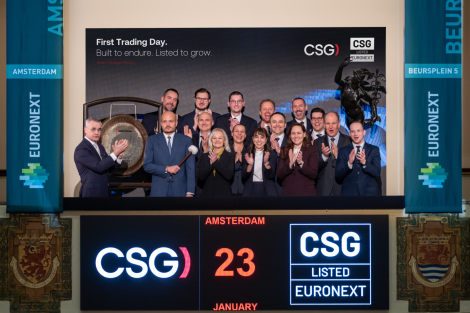 Strengthening Europe’s strategic autonomy through capital marketsCzechoslovak Group lists on EuronextRead more
World’s largest defence IPO ever recorded.
Learn more about Euronext’s initiatives to enhance financing and visibility for European aerospace and defence companies -
Trading
 Where European Government Bonds meet the futureFixed Income derivativesRead more
Trade Mini Bond Futures on main European Government Bonds
-
Clearing
 Step into Europe’s next phase of Repo ClearingRepo ClearingRead more
Euronext is expanding its repo clearing services to boost market access, liquidity provision and collateral optimisation across Europe.
-
CSD
 European CSD modelBuilding the CSD of Choice in EuropeRead more
Euronext Securities is shaping the future of European capital markets by enhancing integration, connectivity, and innovation.
-
Technology
 Euronext Technology SolutionsHigh-Frequency Trading Solution (HFTS)Read more
The new generation of high-frequency risk trading platforms, offering the highest performance with ultra-low latency and minimal jitter, all at a low total cost of ownership.
-
Data
-
Indices
 Access the white paperInvesting in the future of Europe with innovative indicesRead more
The first edition of the Euronext Index Outlook series with a particular focus on the European Strategic Autonomy Index.
-
About Euronext
 Euronext strategic planInnovate for Growth 2027Read more
Shaping capital markets for future generations

Solstad Maritime ASA lists on Euronext
Euronext publishes Q1 2025 results
Market quality analysis on the French stock options market
This analysis focuses on the market quality of the French stock options market, highlighting Euronext’s superior market quality with tighter spreads and larger Best Bid and Offer sizes.
Market quality analysis on the French stock options market
Executive summary
- Euronext demonstrates superior market quality with tighter spreads and larger average Best Bid and Offer (BBO) sizes compared to its competitors. This consistency is observed on first maturities and across different option types - in the money, at the money, and out of the money - with Euronext maintaining better spreads and higher BBO quantities.
- For the top 10 traded underlyings, the observation remains the same: Euronext offers the best market quality for the most liquid French equity options underlying.
- Overall, Euronext's outstanding market quality on French equity options provides enhanced liquidity, demonstrating stability and resilience during market volatility.
To find out more about the performance, download the market quality analysis on the French stock options market.
Download
May 2025
Euronext completes the acquisition of Admincontrol
Euronext announces volumes for April 2025
Euronext strengthens its support for European strategic autonomy with New ESG focused initiatives: Energy, Security and Geostrategy
Thematic European Indices on Energy Security, Strategic Autonomy and Aerospace & Defence
Euronext is introducing a new series of thematic indices focused on companies that contribute directly to Europe’s long-term self-sufficiency. These indices are designed to give investors targeted exposure to firms that are positioned to grow in the current evolving geopolitical environment while playing a crucial role in Europe’s autonomy.
The new indices include:
-
Euronext European Energy Security Index: highlighting companies that are central to ensuring Europe’s energy stability, from conventional and nuclear energy providers to renewables and critical infrastructure
-
Euronext European Aerospace & Defence Index: focusing on the leaders and innovators in aerospace, defence technologies and advanced manufacturing, allowing investment in the continent’s most influential industrial forces
-
Euronext European Strategic Autonomy Index: offering broader exposure to companies that support Europe’s strategic independence and resilience across multiple critical sectors, including defence, energy and technology.
These new flagship indices are designed to serve as reference indices for investment products created by banks and asset managers, allowing capital flows to be aligned with Europe’s long-term interests.
Euronext launches the European Common Prospectus to accelerate capital market integration and boost IPO activity across the EU
Introducing the European Common Prospectus
Euronext introduces the European Common Prospectus to accelerate capital market integration and boost IPO activity across the EU.
Introducing the European Common Prospectus
Euronext has launched the European Common Prospectus, a single, standardised template for equity issuances that enhances capital market integration and cross-border investment across Europe.
To permit long-term European competitiveness and innovation, improving access to European capital markets is essential. While the Listing Act, aimed at simplifying European listing rules, is not expected until June 2026, there is an immediate need to boost IPO activity in Europe. To meet this need, Euronext began to develop its new European Common Prospectus in November 2024, following the publication of the Listing Act.
Harmonisation and standardisation of prospectuses
As the backbone of the Capital Markets Union, Euronext has continuously simplified listing rules, with harmonised rulebooks to enable issuers to tap into our single liquidity pool powered by our single trading platform Optiq®. This new prospectus, designed for use across all Euronext countries, complies with existing EU regulation and offers immediate benefits to both issuers and investors.
The use of the European Common Prospectus is strongly encouraged for IPOs and other equity offerings across Euronext markets. It is already available and can be used immediately. It complements existing prospectus formats, such as the use of tripartite prospectuses, or the EU Growth Prospectus for SMEs and the Follow-on Prospectus, depending on the type of offering.
For issuers: an easy-to-use prospectus template
This streamlined template simplifies and harmonises the equity listing process across all seven Euronext markets—Amsterdam, Brussels, Dublin, Lisbon, Milan, Oslo and Paris—reducing complexity and preparation time for issuers by replacing the traditional 21-section structure with 11 sections. The prospectus uses English to enhance comparability and cross-border access to capital, ensuring greater consistency for investors across jurisdictions.
The template is designed to be flexible and adaptable, ensuring it meets current regulations while being ready to incorporate future changes under the Listing Act, expected to apply from June 2026.
For investors: consistency and comparability of information
The European Common Prospectus ensures greater consistency in how companies present their information, supporting better decision-making across jurisdictions. It offers much-needed consistency and comparability across EU jurisdictions. Whether the prospectus is for a listing in Amsterdam, Brussels, Dublin, Lisbon, Milan, Oslo or Paris, investors will now be able to assess offerings based on a shared structure and language – making it easier to evaluate opportunities and make informed investment decisions.
To ensure broad support and practical implementation, Euronext sought support from European stakeholders including ECM bankers, legal advisors, auditors, investors and issuers.
In summary, the European Common Prospectus brings clear benefits to:
The European capital markets:
- Enhances competitiveness
- Promotes cross-border investment
- Provides a consistent and comparable format
Issuers and investors:
- Easy-to-use template that reduces complexity
- Simplified drafting process (11 sections instead of 21)
- Better comparability
- English as the accepted language across jurisdictions
More about the European Common Prospectus
To learn more about the European Common Prospectus, read the full press release and:
download the European Common Prospectus template
Interested in listing on Euronext? Visit euronext.com/en/raise-capital
Euronext Market Insights: Navigating volatility
Euronext has released its latest report, the Capital Markets Update, offering a data-driven overview of current trends in equity markets and investor sentiment since the beginning of 2025.
Impact of recent global developments on European equity markets
The beginning of 2025 has been a volatile period for issuers and investors as markets continue to adjust to ongoing geopolitical and macroeconomic developments.
Euronext Capital Markets Update
Euronext's report shows an increase in market volatility broadly consistent with historical patterns observed during periods of macroeconomic stress. The current environment appears to be driven by a combination of forced derisking and elevated macroeconomic uncertainty. While this phase may feel pronounced, historical precedent – including episodes such as the COVID-19 market response – suggests that such conditions tend to normalise once initial adjustments are absorbed.

Key insights
-
Volatility trends: Equity markets are facing significant volatility, with the VIX averaging 31 last week (14-20 April) — well above the 5-year norm of 19 — after peaking at 52 in early April. This level, while below those of past crises (COVID-19: 82, Ukraine war: 36, inflation fears: 34), still reflects elevated stress. Historically, the VIX returned to normal within 1.5 to 8.5 months post-crisis. Current spikes are triggering forced selling, especially on large-cap stocks.
-
Market impact of recent US tariffs: The latest tariff announcements have triggered a sharp increase in trading volumes across Euronext markets in early April, particularly impacting large-cap stocks, while activity in mid- and small-caps remained largely stable. The third week of April saw a return to more normal levels, reflecting a stabilising global market environment during a shortened trading week.
-
Sector performance and market rotation: Since the announcement of new US trade tariffs, Euronext markets have shown selective resilience in April, with Real Estate and Consumer Staples standing out in positive territory despite global trade tensions. While some sectors—particularly Energy, Telecoms and Financials—faced pressure due to their exposure to global trade and interest rates, others such as Healthcare and Utilities demonstrated relative stability. Cyclical segments like Tech and Consumer Discretionary experienced only modest pullbacks. Encouragingly, European indices remained resilient last week, supported by strong corporate earnings and renewed optimism in Asian markets regarding trade prospects.
For more information, we invite you to download the report.
Should you have any queries, please contact the Euronext team.