Back

Drawing on its multi-jurisdictional experience, Euronext’s calls for a more efficient, coherent and cost-effective approach to regulatory reporting across the European Union. To make it happen, Euronext brought a number of constructive proposals to the European Securities and Markets Authority’s (ESMA) recent Call for Evidence on a Comprehensive Approach for the Simplification of Financial Transaction Reporting, sharing practical insights as Europe’s leading market infrastructure. As part of the broader legislative agenda, we believe that the European Commission’s upcoming legislative work on market integration must be treated as an opportunity to advance simpler reporting. 

A fragmented framework driving complexity 

The difficulties created by a fragmented regulatory framework and a lack of alignment across regimes contribute to duplicative reporting obligations and increased operational complexity. Persistent complexities include overlapping and time-consuming reporting to different National Competent Authorities (NCAs) across Europe, as reports submitted to NCAs frequently contain data already provided to ESMA. Currently Euronext sends over one hundred files a day to its regulators and ESMA. A lot of the duplication and burden stems from direct reports and legacy files requested by NCAs prior to MiFID II. Duplication also occurs under different regulations, for example the same derivative instruments are reported under MiFIR, EMIR and REMIT.  

Additionally, the multiplicity of data files and physical connections results in a large volume of data being sent several times, often using different formats and/or applications, necessitating separate physical connections with each NCA to transmit reporting information. Finally, there is a suboptimal allocation of reporting duties, which often fall on entities that may not be the most appropriate or best positioned to provide such information.  

As a pan-European operator with multiple supervisory authorities, Euronext experiences these challenges first-hand. “The persistent complexity and lack of alignment across regimes translate into increased operational effort and limited data harmonisation,” Jakub Michalik, Chief Policy Officer at Euronext notes. “Addressing these issues is essential for achieving a truly efficient and coherent European reporting landscape.” 

Overview of duplication at play in regulatory reporting – NCA files 
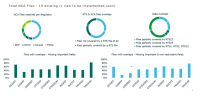
Duplication of regulatory reporting

Euronext’s vision for simplified transaction reporting 

Building on this response, Euronext outlines a forward-looking vision for improving transaction reporting across the EU. Central to this vision are five key priorities: 

  1. The creation of a pan-European data hub under ESMA, or another designated entity, to eliminate the need for separate physical connections and multiple submissions to NCAs. A single technological platform would enhance data quality, improve supervisory coordination and significantly reduce duplication.

  2. Any transaction should only be reported once: Consistency and efficiency should underpin the reporting process. Today, similar datasets are often reported several times under different regulations to different EU agencies. For example, trading venues report selected data under MiFIR RTS 24 to ESMA and similar data to ACER under the REMIT regulation. We propose that RTS 24 which covers order book data, and already has an exhaustive scope, serve as the reference framework and the model to converge toward.

  3. Ensuring the right entities report the right data: Reporting responsibilities should rest with the organisations that actually hold the relevant information – for example, clearing houses on position reporting. This alignment would ensure higher-quality data and reduce the burden on entities lacking full visibility.

  4. Streamlined frameworks with proportional requirements: Reporting frameworks should be kept as simple as possible, providing regulators with the necessary transparency without imposing excessive technical or operational burdens on reporting entities.

  5. A clear roadmap for future simplification: in close collaboration with market participants so that ESMA’s work on this important area can be translated into action.    

A shared objective of efficiency, coherence and cost-effectiveness 

Euronext’s response to ESMA emphasises that simplifying financial transaction reporting is both an operational and strategic necessity. By reducing duplication, enhancing data consistency and improving coordination between authorities, the European regulatory reporting framework can become more efficient and streamlined. Such a well-coordinated reporting framework would benefit both regulators and the market as a whole. By acting together, Europe can build a reporting environment that supports market integrity, reduces costs and fosters competitiveness. 

To reach the necessary objective, the European Commission’s upcoming legislative package on market integration, expected in early December, should be seen as a critical milestone in advancing these reforms. 
Read Euronext’s full response to the ESMA Call for Evidence on the Simplification of Financial Transaction Reporting 

Back

What’s next for your firm in Europe’s evolving repo landscape?

As regulatory priorities shift and market structures evolve, repo clearing has moved to the centre of Europe’s funding conversation. 

Market participants are navigating a complex environment, balancing liquidity needs, collateral efficiency, and risk management, while anticipating the implications of new transparency and prudential requirements.

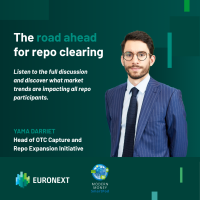
In this short 10-minute episode of the Modern Money SmartPod,  Yama Darriet, Head of OTC and Repo Expansion at Euronext, reflects on how the conversation around cleared repo is changing. 

From the regulatory and balance sheet factors driving adoption, to the importance of access and market design, the discussion explores how clearing is becoming a cornerstone of a more connected and resilient repo ecosystem.

At a time when market participants are looking for simpler, more efficient ways to manage balance sheet capacity and liquidity, the question is no longer if repo clearing will expand across Europe, but how it will shape the next phase of market development.

Listen to the conversation to gain a concise perspective on the forces redefining Europe’s repo landscape — and what they could mean for your firm.

repo clearing

Listen to the 10-minute podcast here.


Back

Submitted by master_of_puppets1 on

Euronext is searching for young talents ready to seize the opportunity to contribute to bridge the gap between software development and operations.

The DevOps Tools team is responsible for designing and implementing solutions to facilitate the Continuous Integration (CI), Continuous Delivery (CD), and automation processes at Euronext.

Back

Submitted by master_of_puppets1 on

We are looking for an Equity admission officer (VIE) to join our Listing Admission team at Euronext. The position will be based in Oslo and will start on 1 January 2026.

You will be primarily responsible for:

Back

Back

Submitted by master_of_puppets1 on

We are looking for a motivated young professional to join us as a V.I.E. event management specialist. The position will be based at Palazzo Mezzanotte, Euronext’s headquarters in Milan, and will start on 1 January 2026.

You will be primarily responsible for:

Back

As one of Norway’s leading banks, Nordea manages a significant number of Share Savings Accounts (ASK) for its clients. Ensuring accurate and timely tax reporting across thousands of accounts is no small task — particularly in a landscape shaped by frequent regulatory updates and growing complexity.

To address these challenges, Nordea sought a solution that could automate tax calculations, reporting to the Norwegian Tax Administration, and the generation of annual investor statements — all while reducing manual workloads and operational risk.

Euronext Securities Oslo partnered with Nordea to deliver the ASK Tax Reporting service — a secure, automated solution that integrates directly with Nordea’s systems. Through a dedicated web interface, the service streamlines ASK-related activities and ensures tax reporting accuracy from start to finish.

Euronext Securities Oslo’s ASK Tax Reporting service has been instrumental in streamlining our tax compliance processes. Their expertise and technology give us confidence that our clients’ tax obligations are managed accurately and efficiently.

— Per-Egil Segersten, Product Management and Oversight, Nordea Bank Abp

Since the implementation, Nordea has achieved a significant reduction in manual processes, improved operational efficiency, and strengthened client trust through transparent and reliable tax handling.

We are proud to support Nordea with our ASK Tax Reporting service, helping them navigate complex tax regulations and deliver a seamless experience for their clients. Our focus is on providing reliability, compliance and expertise. This service demonstrates our commitment to serving the retail investment market.

— Stef Lambersy, Head of CSD Tax Services, Euronext Securities


Back

Submitted by master_of_puppets1 on

Legal Department : Début du stage - Juillet 2026

Le Département juridique assure pour le compte du groupe Euronext des missions de conseils et d’assistance juridiques tout en contribuant à la bonne gouvernance du groupe. Ses missions ont trait à des aspects juridiques et réglementaires. 


Back

Submitted by master_of_puppets1 on

Join us as an HR Project Officer in our International Graduate Programme (V.I.E)!

Are you ready to kickstart your career with the leading European market infrastructure? Euronext is seeking a dynamic and motivated candidate to join our group Talent team within the International Graduate Programme (V.I.E). The position is based in Milan, starting in January or February 2026 and reporting to the Head of Talent.

Back

The competitiveness of EU capital markets

As stated by the European Commission, the priorities for the MiFID/R review are "to improve transparency and availability of market data, improve the level-playing field between execution venues, and ensure that EU market infrastructures can remain competitive at international level”. To achieve this, there must be a diverse and sound trading landscape, enabling investors to select between various execution venues and market models in an environment where price formation and market integrity are protected. In the new macroeconomic normal, dominated by inflation and high interest rates, the need for strong market-based financing versus increasingly constrained bank-based financing is paramount. To achieve this, we need an investment and trading environment that can be trusted by all market participants, enables an efficient allocation of capital via robust price formation and provides open and fair competition for all participants.

European stock exchanges have invested significant resources to play their major role in financing the real economy and in fostering listing and SME financing. They support European countries in building robust financial markets, promoting strong financial industries and attracting international investments to truly service local economies. Exchanges are the venue of reference for price formation and price improvement, even more significantly when volatility hits the markets. Thank to their continuous investments and innovation, stock exchanges support fair and orderly trading to benefit of the whole ecosystem. They have been able to adapt and innovate to meet the needs of their various clients, from issuers to final investors and to the broader economy as a whole.

Euronext remains strongly committed to building the backbone of the Capital Markets Union. This is why we believe it is of paramount importance to ensure that the MiFID/R Review reinforces the competitiveness of EU markets. The outcome of the MiFID/R Review in this respect will define whether the EU has an ambition to be a continent of finance-makers, or accepts to be merely a territory of finance-takers. There are three key issues at the heart of the Review that require particular scrutiny: the establishment of a Consolidated Tape (CT) that brings true value to market participants; a ban on Payment for Order Flow (PFOF) to ensure retail investors get the best services by preventing conflicts of interest, and better balancing of lit and dark trading, meaning that Systematic Internalisers (SIs) are placed under proper regulatory oversight.

Our 3 key priorities

  • Consolidated tape
    Promote an equity Consolidated Tape that brings true value to market participants – a Consolidated Tape with real-time post-trade data and pre-trade snapshots.
  • PFOF Ban
    Ensure retail investors get the best services by preventing conflicts of interest – Payment for Order Flow Ban
  • Level Playing Field for Systematic Internalisers
    Better balancing lit and dark trading – proper regulatory oversight for Systematic Internalisers 

Consolidated Tape

Supporting Consolidated Tapes that improve competitiveness of EU markets.

The primary objectives of the CT set by the Commission in the initial proposal, were to improve transparency and reduce market fragmentation.

There is a strong case for the creation of Consolidated Tapes on non-equity markets – namely a Consolidated Tape for bond markets and a Consolidated Tape for ETF markets - which will foster broader participation into these asset classes across European markets.

Turning to equities, the position of the Council, that was already a step further from the initial European Commission proposal, would allow the dissemination of information in real time on transactions in equities across all EU venues, together with the prices available on the markets at the time of their execution. It would give all European market participants (issuers, retail and institutional investors and intermediaries alike) easily accessible consolidated information on the overall liquidity available across European markets, supporting all non-trading use cases, including best execution analytics, in flight analysis and portfolio valuation. As such, it would be a powerful tool to support the Capital Market Union, by equipping participants with the information necessary to take investment and trading decisions on EU listed equities as well as to operate core middle- and back-office functions.

In contrast, the trading tape proposed by the European Parliament, would inevitably distort the market. From a market structure standpoint, the Parliament’s proposal for a real-time pre-trade tape with five levels of depth would drive trades away from lit markets, by supporting more dark trading at the tape’s pre-trade reference price. It would facilitate the arbitraging to the detriment of retail investors, thereby increasing market fragmentation and enabling unfair treatment of market participants depending on their level of sophistication. Looking at the concrete outcome of the main live example to date – the US tape, a trading tape  basically favours non-transparent markets and non-transparent trading. That's because the real-time pre-trade tape becomes a reference price, that can be easily imported by dark pools to allow trading away from lit markets. From an operational standpoint, it would be complex and costly to set up from scratch. As a result, established players already active in the space, have a huge advantage, from a capabilities, costs and risks standpoint to win and operate such a tape vs non data vendors. Therefore, the participants supporting the European Parliament’s proposed tape are advocating for a regulation that would be to the detriment of European public capital markets and the exchange infrastructure that supports them, as well as in direct contradiction to the original policy aim of increasing transparency.

That is why Euronext has advocated for a tape that brings true value to European capital markets and contributes to the development of the Capital Markets Union. We believe the Council text can, and should, present a compromise based on the notion of a real-time post-trade tape, supplemented with a snapshot of pre-trade information from the point of execution. Only this solution would improve the competitiveness and transparency of EU financial markets, to the benefit of all EU and global investors, from individual retail investors to large asset managers, without distorting the market and giving disproportionate advantage to a small group of major market participants.

Our ask:
Euronext does not support the inclusion of pre-trade data in the tape along the model proposed by the European Parliament. We believe the Council text can present a compromise based on the notion of a real-time post-trade tape supplemented with a snapshot of pre-trade information from the point of execution. 

PFOF Ban

A full ban on Payment for Order Flow.

Sustained investor participation in European financial markets is critical to having an environment that can be trusted by all participants. PFOF hinders retail investors as it de facto entails conflicts of interests which are particularly acute for retail investors who naturally suffer from information asymmetries versus professional market participants. It is therefore intrinsically contradictory to the objective of financial markets providing fair treatment to all participants. With PFOF models, the broker will always have an economic incentive to direct order flow to the execution venue or counterparty that offers the highest payment or discount, and not necessarily the best outcome for its clients.

In addition to the issue PFOF raises when it comes to the protection of individual investors, it has also more structural impacts on market structure. First, by undermining market fairness, it risks ultimately decreasing retail investors’ trust and hence participation in financial markets. In addition, the use of PFOF, because it mechanically equates to the privatisation of retail flow execution  - which is no longer executed on lit and multilateral venues but under private deals - also results in a less transparent and less efficient price formation mechanism. PFOF therefore negatively distorts competition and the overall functioning of capital markets.

This is why we believe that a full ban on PFOF is the only way to ensure retail investors are protected and to support well-functioning capital markets.

Our ask:
Euronext strongly believes that a full ban on Payment for Order Flow is the only way to ensure investor protection is not compromised, given the inherent conflict of interest risks.


Level Playing Field for Systematic Internalisers

Promoting a level playing field for Systematic Internalisers.

SIs need proper regulatory oversight in order to maintain a balance between lit and dark trading that is fair for investors, maintains market integrity and prevents market abuse and fair competition.

SIs enable to execute flow away from multilateral and lit venues onto purely bilateral venues where client orders are being matched against the proprietary capital of the SI operator. They were initially designed to provide an execution alternative, notably to execute large trades that required bespoke liquidity. By construction, SIs do not contribute to price formation and de facto privatise flow execution.  They have become an integral part of the diverse European trading landscape yet protecting price formation and market integrity across European markets require SIs to operate on a level playing field with other execution venues.

This is why we believe that the requirements applicable to SIs be brought at par with those already applicable to other execution venues in the EU and that the exemptions allowed to SIs to trade away from displayed prices (i.e., midpoint trading) be limited only to legitimate circumstances (large orders), as per the initial European Commission’s proposal. If the European Commission, Council and Parliament fail to retain the Commission’s original proposals, there is a risk that the amended proposals will result in less transparency, more fragmentation, more bilateral trading (to the detriment of the end investor) and will hinder progress towards the Capital Markets Union.

Our ask:
The forthcoming trilateral negotiations, including the European Commission, Council and Parliament, should agree to retain the Commission’s original proposals on market structure, in order to protect transparency and ensure a level playing field, thereby helping Europe move closer towards achieving Capital Markets Union:

  1. Prevent midpoint matching for small orders (as per Commission proposal, i.e. below twice the standard market size – €20k);
  2. Retain tick size regime for all orders executed on Systematic Internalisers up until the large-in-scale threshold (as per the Commission proposal);
  3. Regulate Systematic Internalisers appropriately to ensure an equal and fair level of regulatory oversight to maintain Europe’s robust regulatory framework. Systematic Internalisers should therefore be subject to the same principles as any other trading venue.